
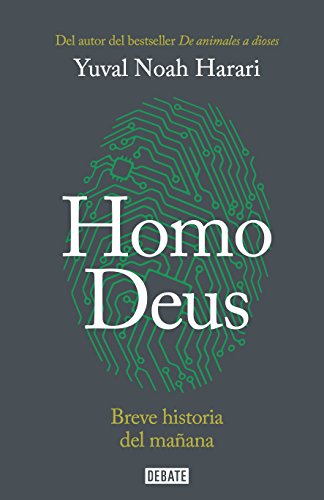
Homo deus : breve historia del mañana / Yuval Noah Harari ; traductor Joandomènec Ros i Aragonès
Material type: TextSeries: DEBATE. Historia (Penguin Random House)México : Penguin Random House Grupo Editorial, 2019Edition: 1a ediciónDescription: 492 páginas : ilustraciones, mapas, gráficas, fotosContent type:
 - texto
- sin medio
- volumen
- 978-607-314-989-1
- Homo deus : a brief history of tomorrow. Español
- 808.84935 H37 H66 2019 20
- CB428 .H368513 . .H37 2019
| Cover image | Item type | Current library | Home library | Collection | Shelving location | Call number | Materials specified | Vol info | URL | Copy number | Status | Notes | Date due | Barcode | Item holds | Item hold queue priority | Course reserves | |
|---|---|---|---|---|---|---|---|---|---|---|---|---|---|---|---|---|---|---|
| Libro | Ingenieria Agroindustrial | Literatura | 808.84935 H37 H66 2019 (Browse shelf(Opens below)) | Ej. 1 | Available (Préstamo 15 días) | 1108014821 | ||||||||||||
| Libro | Ingenieria Agroindustrial | Literatura | 808.84935 H37 H66 2019 (Browse shelf(Opens below)) | Ej. 2 | Available (Préstamo 15 días) | 1108014822 |
Sapiens explicó cómo la humanidad llegó a dominar el planeta. Homo Deus examina nuestro futuro. Combina la ciencia, la historia, la filosofía y todas aquellas disciplinas que las interrelacionan ofreciendo una visión del mañana que al principio puede parecer incomprensible pero que después se presenta como innegable: la humanidad perderá pronto no sólo su dominio sino su propio significado. Tampoco deberíamos resistirnos: mientras nuestro motivo favorito en la ciencia ficción imagina a los humanos luchando contra las máquinas en nombre de la libertad y el individualismo, en realidad estos mitos humanistas han sido descartados desde hace tiempo, tan obsoletos como las cintas de casete o las danzas de lluvia. Esto puede sonar alarmante, pero el cambio siempre es aterrador.
Durante el siglo pasado la humanidad ha logrado hacer posible lo imposible, frenando el hambre, la peste y la guerra. Hoy en día, más personas mueren de obesidad que por hambrunas; más personas mueren a causa de la vejez que por las enfermedades infecciosas; y más personas se quitan la vida de las que mueren a causa de un conflicto bélico. Somos la única especie en la larga historia de la Tierra que ha sido capaz de cambiar el planeta entero, y ya no esperamos que ningún ser superior moldee nuestros destinos.
"Over the past century, humankind has managed to do the impossible and rein in famine, plague, and war. For the first time ever, more people die from eating too much than from eating too little; more people die from old age than from infectious diseases; and more people commit suicide than are killed by soldiers, terrorists and criminals put together. The average American is a thousand times more likely to die from binging at McDonald's than from being blown up by Al Qaeda. What then will replace famine, plague, and war at the top of the human agenda? As the self-made gods of planet Earth, what destinies will we set for ourselves, and which quests will we undertake? Homo Deus explores the projects, dreams and nightmares that will shape the twenty-first century -- from overcoming death to creating artificial life. It asks the fundamental questions: Where do we go from here? And how will we protect this fragile world from our own destructive powers? This is the next stage of evolution. This is Homo Deus." --Publisher's Web site.
There are no comments on this title.